Artist-Residence | Het Lage Noorden 2026
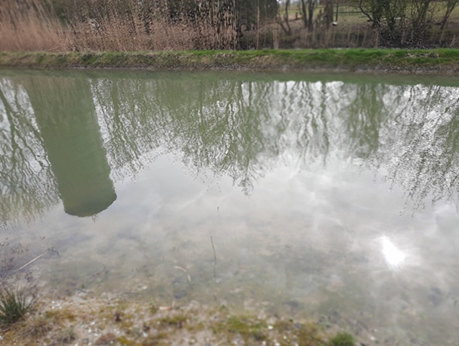
From March 30 through
April 3,
I stayed at Het Lage
Noorden for a mini-art residency.
Over the course of five
years,
the former farm has been
transformed by its new owners,
Sandra Jansen and Stephan
Valk, into
an unique art and research space in northern
Friesland.
Located along the inner
dike,
with the vast salt marshes
of the Wadden Sea region
stretching out behind it.
Remarkably, I found myself
with plenty of time,
thanks to a flexible
schedule that I adjusted daily.
Day by day
March 30
Meetings with: Stephan Valk, Sandra Jansen _H_L_N_,
Fellow residents *Maartje
Meerman (NL), *Maarten de Naeyer (B),
*Connie Snoek (NL), *Katharina Langer (D).
Together with the art
residents,
I stayed in the
guesthouse, which had a private room,
a shared living-kitchen,
and
an immense workspace in
the adjacent tall, long barn.
With groceries for the
whole week and taking turns cooking,
there was plenty of time from
early morning until late at night
to explore the
surroundings, the situation, and test out my work.
March 31
The second day.
I explored the grounds and
took a walk of about three hours.
Across the salt marsh dike
toward the mudflats,
via the only permitted
path during the breeding season,
I heard the biting wind
and the thousands of foraging
and nesting migratory
birds.
The sounds of chickens and
sheep,
the hint of mice—as
evidenced by the many holes in the grass—
and exploring the fully
restored farm complex
all combined to create a
magical, alluring atmosphere.
This was further enhanced
by the constantly changing
cloudy skies throughout
the day and evening,
with subtle light effects
and panoramic views
Observing, watching,
something to see, smell,
and feel everywhere,
the salt marsh clay and
silt beneath my feet,
half-dried with regularly
cracked structures and patterns.
Dikes covered with grass,
behind them, the lower-lying salt marshes,
still almost bare at this
time of year,
where now, after winter,
all manner of things is beginning to sprout,
and in between, in the
mudflats, bird tracks and carcass remains,
already fossilized, lying
dramatically on the surface.
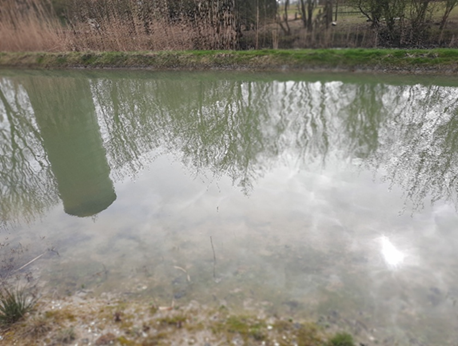
Experimenting
In the afternoon, I laid
out the clay, bone, and eggshell finds
on a worktable in the
large project barn and made a note.
A first encounter is best
preserved in memory.
On a second visit to the
same place,
memory interferes with the
first recollection.
And as a result, that
first impression changes or fades.
Would notes help or get in
the way?
Capturing it seems
impossible,
but you can get close with
descriptions,
making drawings and
performing rituals or actions.
I diluted the oily clay
and slurry with water
and tested the pigment in
a calligraphic manner.
Waiting, letting it dry,
surrounded and held in place by rubber boots
While waiting, I looked at
a piece I’d brought along in the large space
with good overhead light.
From where?
I began this drawing I
brought with me
during a previous
residency at Arteventura in 2025 in Spain.
*See the link (below) to
‘work period
and the exhibition BROTA
EL PUEBLO’
I brought this
accordion-folded work
(as a *aide-mémoire) with
me from The Hague
to this North Frisian
region, which, like the Arteventura area,
has protected nature
status.
A different natural
environment, different soil,
a different climate, a
different way of life, a different culture.
My intention was to insert
new drawings.
I also discovered that I
wanted to move the long,
flexible folded work
differently.
With a different intention
than I had felt earlier in Andalusia.
Now more in the form of
the undulating flow of mudflats, water,
bird migration, and
turbulent wind.
The caterpillar-like whole
also allowed itself to be carried along easily in waves,
especially after I hung it
from a string (suspended from the ridge).
How different was
Andalusia?
Here I was more captivated
by the combination of
culture and nature, its
earthiness,
the close connection of
the residents of the village
of Corteconcepcíon
to their land,
the traditions expressed
in clothing,
flamenco rhythm, dance,
music,
the still-cherished
bullfights, and theatrical Catholic processions
that swept me deep into my
body.
This led to a suspicion
that
there is even more “inner
life” to discover
and that the power of
memory
still holds many
surprises.
I used the ten-meter roll
of paper I’d brought to Andalusia for a drawing
that began with an
intention: one meter a day for notes and drawings.
It began with a
resolution: one meter a day for notes and sketches.
And as time went on
I found that unrolling and
rolling it up didn’t satisfy me,
I started folding the
paper every 10 cm.
Thinking of accordion and
fan shapes.
This was followed by my
amazement at the flexibility,
performative and
sculptural possibilities of the large leporello.
This led to further form
experiments.
Meanwhile, regularly
adding new notes,
I began to think about how
to proceed. The work was in a sort of limbo.
*See the Arteventura page on the site for this period of work.
By taking this drawing,
this *Aide-Mémoires, with me on my travels,
and continuing to work on
it in between, I believe I can create
a (more conscious?) exchange
between the outer world and the inner world.
Evening darkness:
At the end of the second
day, a dinner was provided (Sandra and Stephan)
for everyone + 1 (Wies Noest).
Introductory stories
followed.
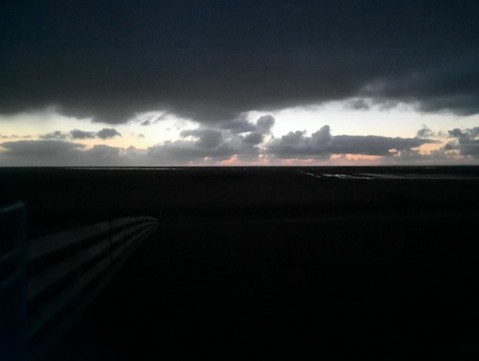
In the last light on the
horizon, I walked up the dike for a moment
under the full moon,
stars, and lighthouse light.
Thoughts during the days that followed:
As I reflected on my
impressions from the first day, associations
and the the word “body” came to mind.
How open are bodies? What
is allowed in
and what flows out?
Boundaries?
And again, the question:
“How does my body register and process
the new and unknown?”
And what do different
bodies bring about in each other?
(A country or a creative
organization can also be considered a body.)
Does the soul change, or
only the characteristics to make adaptation possible?
I want to find words for
this, to let my imagination run wild.
Is there a distinction
between image and word during internal bodily registration?
If not, how do you represent
simultaneity? In the Wadden Sea region, I experience something new and
something familiar at the same time.
Keeping in mind the body
you brought along on your journey, how do new experiences connect with previous
ones?
If I regard the artworks
I’ve brought along as animated bodies with specific characteristics,
how does my body form a
connection with them?
What flows in, what flows
out, what remains, what disappears?
Longing and loss both sit
comfortably and uncomfortably within my body.
Imagination is already
exploring the next unknown.
April 1
Observer’s dilemma. Attempt to be present yet absent
This became the day of the
animals.
I sat for a while with the
sheep, the cat, and the chickens.
I approached them all
cautiously and observantly.
With the sheep, I tried to
make myself seem absent.
I submitted one of the
videos I made that day
to the online *Festival of
the Smallest 2026
April 2
Artists *Leontine Lieffering and Bart Benschop
came to visit on
this third day.
Together, we explored the
land, the biotopes, structures,
and facilities of Het Lage
Noorden on a walk,
and later we drove to the
Wadden Sea region
with a view of Ameland
(the Holwerd pier),
with spectacular light on
the water and a cloudy sky.
April 3
Residents are asked to
leave behind an archive box
containing “whatever, no
pressure” findings from their stay.
It took me a while to
figure out what I wanted to leave behind.
By then, I had almost
thrown the form away,
in the spirit of “No
Pressure,”
but I thought back to my
intention for this short residency.
After all, this is a first
exploration.
I had to think of other
explorations and the observations linked to them.
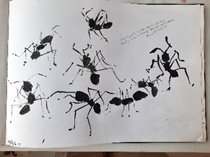
As for the ants?… I didn’t see them anywhere
And yet they suddenly
appeared in drawings
during my stay at Het Lage
Noorden in 2026.
Apparently, the ants live
in my head.
During the first of my two
residencies at *Arteventura in 2023,
I began observing the
(one-centimetre-long) ants living there.
This nearly daily
observation had consequences.
For example, I wondered
how ants work together and how they recognize one another.
More questions followed.
From that moment on, they
appeared in drawings, on clothing, and in paintings.
Since then, I’ve also been
creating “exchange ants” on small scraps of paper
and giving them away as a
token of gratitude and joy in encounters and exchange.
Just before leaving at the
end of March for HetLageNoorden,
I stayed in the family
forest house in the Veluwe, where I noticed the many
ants.
Ants that weren’t marching
in a column
but were wandering all
over the kitchen counter on their own.
I looked up information
about this behaviour.
The scouts among the ants
go out in search of food and building materials
and bring them back to
their nest with the knowledge of “where they came from.”
The others can then, if
needed, head for the food en masse in a column.
The mini residence put me
on the trail of that specific scout’s position.
The “Aha!” moment then
clicked in my mind.
I named the archive box
I was filling “Aide-Mémoires.”
I made a fold-out sheet
for this with drawings of scout ants.
I stuck a stack of Aide-Mémoires (13+1 notes filled with experiences)
to the inside of the box,
and beneath the drawing I
placed the crumpled A4 form
with a found down feather
glued to it, accompanied by the note “Soft Landing.”
A.I.R. Arteventura + exhibition BROTA EL PUEBLO
https://thesmallest.222lodge.nl/ellen-rodenberg-observers-dilemma-2026/
*The location + fellow residents +
https://www.conniesnoekillustrator.nl
https://www.katharinalanger.de
https://www.maartjemeerman.nl/
+